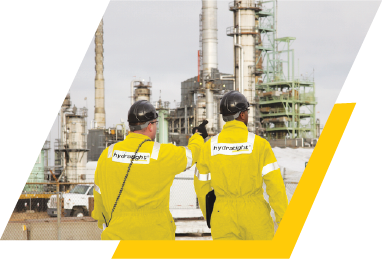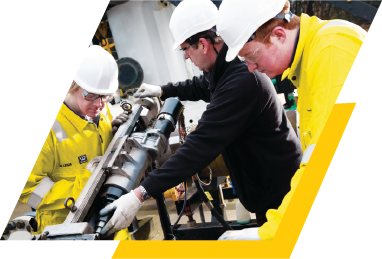
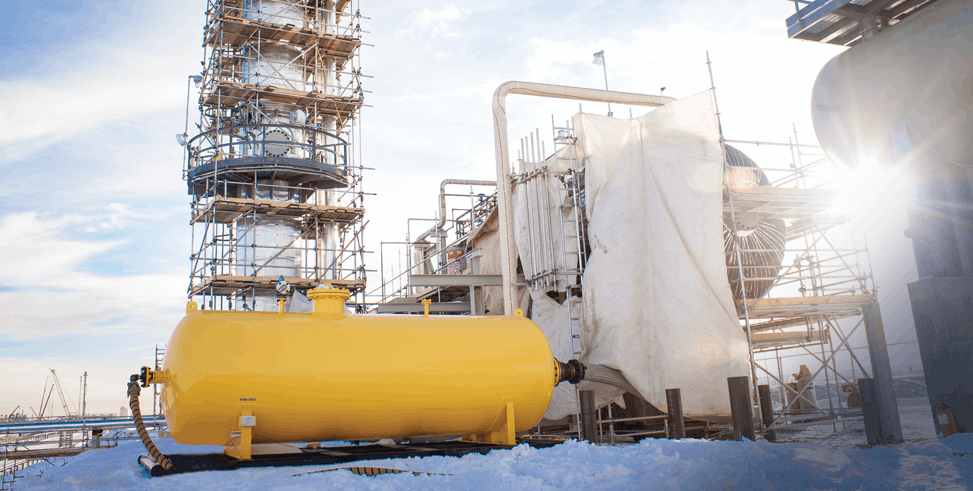
The difficulty is that these problems rarely fit neatly into one service category. A flange problem may require engineering assessment, controlled bolting and machining. A planned shutdown may involve joint integrity, process cleaning, testing and specialist field services. A live leak may require an engineered repair that avoids taking the asset out of service.
This is where a broad, integrated technical capability can make a difference.
Hydratight provides specialist services covering joint integrity, controlled bolting, on-site machining, live-asset intervention, process services and pipeline services. The appropriate combination depends on the condition of the asset, the operating environment, the maintenance objective and the constraints of the project.
Above: Interactive Overview of all services provided by Hydratight. (Services vary by region)
For an asset integrity or maintenance team, the first question is rarely “Which service should we buy?” It is usually “What is preventing this asset from operating reliably, and what needs to happen to put it right?”
That might mean preventing a flange leak before a turnaround is complete, restoring a damaged sealing surface, repairing a component without removing it from site, cleaning a system before commissioning or finding a way to carry out essential work without interrupting production.
The interactive capability overview accompanying this article provides a useful way to explore the range of services available. The important point is that these capabilities can address different stages of an asset's maintenance and operating lifecycle, from planning and preparation through intervention, testing and return to service.
Bolted joints are a fundamental part of process plant, but achieving reliable flange integrity involves more than applying torque to a bolt.
Joint condition, flange alignment, tightening procedures, equipment selection, inspection and documentation can all affect the result. Hydratight's Integrity Assurance services combine engineering support, joint integrity management software and on-site services to provide a structured approach to managing critical bolted connections.
Controlled bolting provides the execution capability, using calibrated torque and tensioning equipment and trained technicians to tighten critical joints to known values. Services include precision torque, hydraulic tensioning, flange disassembly and flange alignment and pulling.
The value of this approach becomes particularly apparent during turnarounds, where hundreds or thousands of joints may need to be managed within a defined outage window.
At Calumet Superior's 2017 refinery turnaround, for example, Hydratight was responsible for full iDMS tracking of 950 flanges ranging from ¾ to 60 inches. The work included gap analysis, criticality review, inspection and tracking of high-risk joints. The project achieved a leak-free startup, zero lost-time incidents and completion on schedule.
Not every maintenance problem can be solved by removing a component and sending it away for repair. On large industrial assets, access, transportation, outage duration and equipment size can make that approach impractical.
Hydratight's machining capability includes flange facing, pipe cutting and beveling, drilling and tapping, line boring, linear and orbital milling, electrical discharge machining and metrology. The services are designed to bring precision machining capability to the asset rather than requiring the asset to be moved to a workshop.
This can be particularly relevant where damaged or worn surfaces need to be restored during planned maintenance or where an unexpected machining requirement emerges during an outage.
A refinery upgrade case study, for example, demonstrates how on-site machining and weld testing were used to accelerate a major project, while other Hydratight case studies show field machining being used to restore critical equipment and components.
Some maintenance problems occur on equipment that cannot easily be taken offline.
Hydratight's Online Services cover interventions including leak sealing, composite wrapping and repair, hot bolting, valve testing, pipe freezing and other live-asset services. The objective is not simply to keep equipment running; each application has to be assessed against operating conditions, safety requirements and the engineering constraints of the intervention.
A North Sea example illustrates the type of problem involved. An unmanned offshore production platform had accelerated fastener corrosion affecting more than 100 four-bolt flanges. Hydratight carried out an assessment and used MorSafe™ restraint clamps to enable controlled hot bolting on applicable live systems. The programme avoided 250 man-hours of shutdown and was completed with zero downtime and zero incidents.
In another application for Total E&P Congo, two subsea water-injection riser flanges were leaking. A custom MORSEAL™ flange enclosure clamp provided a low-profile repair without subsea welding. The 11-day operation restored pressure integrity while production continued.
These examples demonstrate an important principle: where shutdown avoidance is a priority, the engineering solution has to be designed around the operating asset rather than treating the maintenance activity in isolation.
Maintenance does not end when mechanical work is complete. Process systems may also need to be cleaned, flushed, dried, tested or prepared for commissioning.
Hydratight's Process Services include chemical cleaning, hydro-jetting, lube oil flushing, steam and air blowing, water flushing, nitrogen purging, hydrostatic and pneumatic testing, and nitrogen and helium leak testing. The stated objective is to remove contaminants, verify system integrity and prepare systems for safe operation or return to service.
These activities can be particularly important around commissioning and shutdown work, where cleanliness, testing and verification can affect the ability to start equipment on schedule.
A case study involving high-velocity lube oil flushing, for example, demonstrates the role of specialist process services in preparing critical rotating equipment for compressor startup.
Pipeline maintenance brings another set of challenges. Cleaning, drying, dewatering, testing and product displacement may be required at different stages of a pipeline's life, from commissioning through operation and eventual decommissioning.
Hydratight's Pipeline Services cover mechanical and chemical cleaning, dewatering, drying, flooding and hydrotesting, nitrogen inerting, product displacement and decommissioning. The services are intended to address contamination, corrosion control, integrity verification and preparation for operation or handover.
The practical requirement is often coordination. A pipeline intervention may involve several activities that need to happen in the correct sequence to meet a commissioning or maintenance schedule.
For asset integrity and maintenance teams, the advantage of a specialist service partner is not simply having a long list of capabilities.
It is the ability to determine which intervention is appropriate, engineer the work around the asset and operating conditions, and execute it with the required equipment, personnel and controls.
Hydratight's case studies demonstrate this across different applications. A Goliat FPSO project involved more than 55,000 flanged joints and required specialist joint integrity engineering, inspection, controlled tightening and digital traceability from construction through hook-up and commissioning.
At a refinery turnaround, the emphasis was on criticality assessment, joint tracking and controlled execution. Offshore, the requirement may instead be to repair or upgrade a live asset without interrupting production. Elsewhere, the problem may be damaged equipment that needs precision machining in situ or a process system that requires cleaning and verification before startup.
The common requirement is competent execution based on the specific condition and constraints of the asset.
Hydratight’s service capabilities span a broad range of industrial maintenance and asset integrity requirements, with specific services and capabilities varying by region. Local teams can advise on the services, technical expertise and field support available for your location and project requirements.
Whether the need is planned maintenance, turnaround support, asset integrity management or an urgent intervention, discussing the requirement early can help identify the most appropriate solution and available support.
How to Repair Critical Pipeline & Process Equipment Failures Without Shutdown
February 25, 2026
Electrical Discharge Machining (EDM): Precision Material Removal for Critical Components
February 25, 2026
Pipeline & Process System Cleaning: An Overview for Oil, Gas, Petrochemical & Power Industries
February 19, 2026
Why ASME PCC-1 is the Benchmark for Bolted Flange Joint Assembly
February 12, 2026