Clamshell cutters provide an alternative. These portable, split-frame machining systems fit around the outside diameter of a pipe and machine around its circumference. They can be used for controlled pipe severing and weld preparation, including beveling, while allowing machining to take place where the pipe is installed or being fabricated.
For industries such as oil and gas, petrochemical, power generation, nuclear and shipbuilding, the ability to produce accurate, weld-ready pipe ends on site can help reduce unnecessary handling and keep maintenance, fabrication and shutdown work moving.
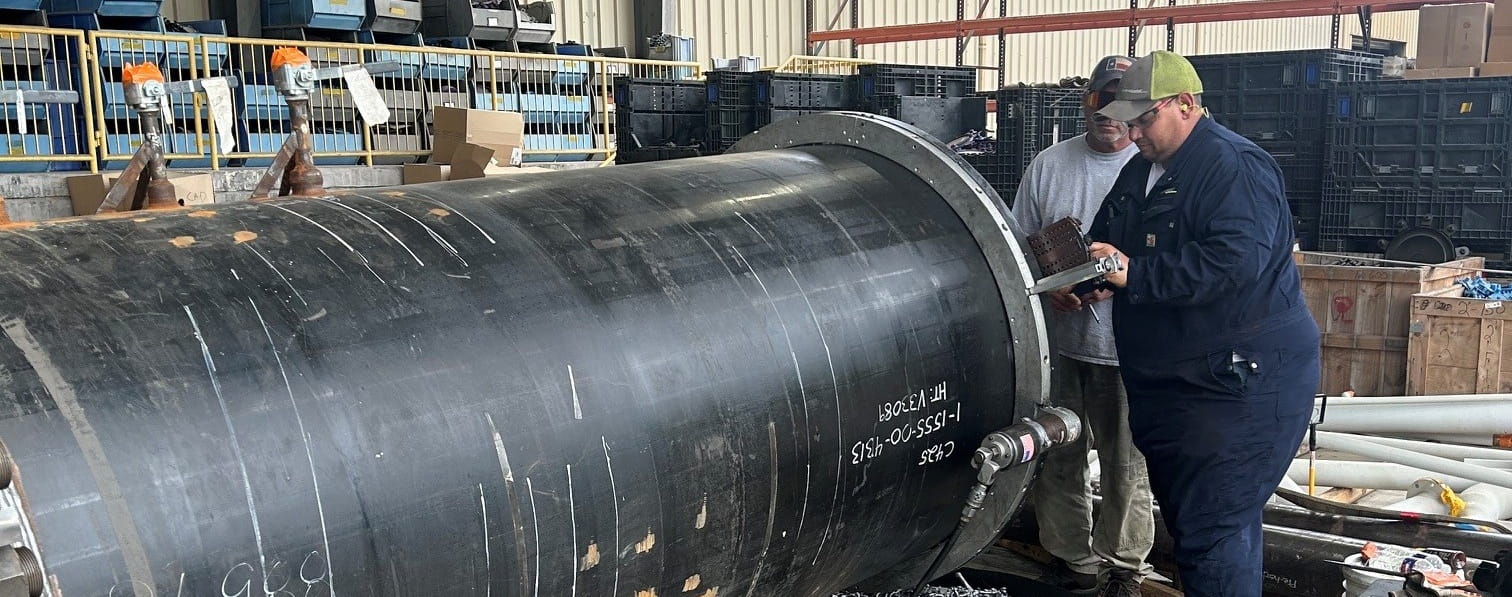
A clamshell cutter, also known as a clamshell lathe, split-frame cutter or pipe cold-cutting machine, is a circular machining tool that is mounted around a section of pipe. The machine is split into sections so it can be installed around pipework without requiring access to the pipe end.
Once mounted and aligned, the cutting tools rotate around the pipe to produce a controlled circumferential cut. Depending on the tooling and machine configuration, the same equipment can also perform beveling and other forms of weld preparation.
Cold-cutting machines are commonly used for pipe cutting and beveling because the machining process does not rely on an open flame or introduce the heat associated with thermal cutting. This makes them particularly useful where control of heat input, sparks or the condition of the pipe material is important.
Hydratight's pipe cutting and beveling service uses a range of clamshell cutters, including narrow-body, mid-size and heavy-duty machines, to cover different pipe diameters, wall thicknesses and access conditions.
The choice of cutting method is determined by the pipe material, dimensions, location, required finish and project constraints.
One of the main advantages of a clamshell cutter is that it performs a mechanical cut without creating a heat-affected zone. This can be important when preparing pipe for welding or when working with materials where control of heat input is a consideration. Cold cutting also avoids the sparks and flame associated with many thermal cutting processes.
The machine can also be used to produce a controlled and repeatable pipe end. This matters when the cut is followed by welding, particularly where accurate fit-up and consistent weld preparation are required.
For maintenance and turnaround teams, the ability to machine pipe in position can also reduce the need to remove sections of pipe and transport them to a workshop. In fabrication applications, it can provide a repeatable method of severing and preparing multiple spools to specified dimensions.
Clamshell cutters are used across construction, maintenance, fabrication, refurbishment, and decommissioning applications. Typical applications include:
A clamshell cutter can make a controlled circumferential cut to remove a section of pipe or bring a spool to the required length. This is useful during plant modification, replacement work and fabrication, where dimensional accuracy can affect subsequent fit-up and installation.
The machine can also be configured to produce the required weld preparation, rather than simply making a square cut. Depending on the welding requirement, tooling can produce profiles such as standard bevels, compound bevels and J-preparations. The correct profile and tooling need to be selected according to the pipe dimensions, material and specified weld preparation.
Combining severing and weld preparation in one machining process can reduce handling and provide a more controlled workflow.
Industrial pipework can present significant machining challenges when diameters and wall thicknesses increase. A suitable clamshell machine needs to accommodate the pipe dimensions while providing stable mounting and sufficient cutting capability.
Hydratight's recent LNG fabrication project demonstrates this range. More than 200 spools were machined, covering pipe diameters from 8 to 72 inches and wall thicknesses up to 3.75 inches. Heavy-duty, mid-size and narrow-body clamshells were selected according to the spool sizes and geometries.
The split-frame design is particularly useful as it does not rely on the machine needing to slide over the end of the pipe. This is vital in installed plant, congested pipework areas and other locations where access is limited. Machine selection becomes especially important in these applications because the physical envelope of the equipment, pipe diameter and available working space all need to be considered.
The Ivanpah Solar Farm project provides an example of this type of challenge. Hydratight used NB Series clamshell lathes on high-energy piping in tight "fire box" locations, with pipework ranging from 4-inch to 74-inch diameter and including heavy-wall P91 material.
The machine itself is only part of the solution. Correct machine selection and tooling are important to achieving the required cut and weld preparation. The first considerations are the pipe outside diameter, wall thickness and material. These determine the appropriate machine configuration and cutting tools.
Access is another key consideration. Narrow-body clamshell cutters can be advantageous where space around the pipe is restricted, while larger heavy-duty machines may be appropriate for larger or heavier-wall pipe.
Tooling also needs to match the application. Severing and beveling require different tool configurations, while the required weld preparation may determine whether standard, compound or J-prep tooling is appropriate. Material can also influence tooling selection, particularly when machining harder or more difficult-to-cut alloys.
For a project involving multiple pipe sizes or materials, selecting the equipment and tooling as part of the overall machining plan can be more effective than treating each cut as an isolated task.
The right approach depends on the frequency and complexity of the work, available personnel and the level of machining expertise required.
An on-site machining service can be appropriate when the work is technically demanding, time-critical or outside the normal capability of an in-house maintenance team. A specialist contractor can provide the machine, tooling and trained personnel and manage the machining operation on site.
Clamshell Rental can make sense when an organisation already has competent personnel and needs specialist equipment for a defined project, shutdown or occasional application. Hydratight's rental offering includes clamshell pipe cutting and beveling machines alongside other on-site machining equipment.
Purchase may be appropriate for organisations with recurring machining requirements and the personnel, tooling and maintenance arrangements needed to operate the equipment effectively.
The decision should therefore consider more than the machine purchase price. Availability, mobilisation, tooling requirements, operator competence, project duration and the consequences of an incorrect cut or weld preparation can all affect the overall cost and risk.
The value of clamshell machining is most apparent when pipe preparation has a direct bearing on a larger project schedule.
On the recent LNG fabrication project mentioned above, Hydratight machined more than 200 heavy-wall piping spools, severing them to length and producing compound weld preparations. The combination of different clamshell configurations, specialist tooling and trained technicians enabled the work to be carried out consistently across a wide range of spool sizes.
At the Ivanpah Solar Farm, NB Series clamshell lathes were used for field machining of high-energy piping and valves. The equipment was selected in part because of the restricted working environment and wide variation in pipe dimensions. The project included high-grade chrome and P91 pipework and field machining operations that continued for 13 months.
These applications illustrate why clamshell cutters are not simply general-purpose pipe cutting tools. Machine configuration, tooling, access, material and the required weld preparation all need to be considered as part of the machining solution.
For critical pipework, the objective is not simply to cut the pipe. The machining process needs to produce the required result safely, accurately and in a way that fits the wider maintenance, fabrication or construction plan.
Hydratight can support this requirement through on-site pipe cutting and beveling services, providing equipment and technically trained personnel for demanding applications. Where customers have their own competent teams, clamshell cutters are also available through the Hydratight rental offering, providing access to specialist equipment without the need for permanent ownership.
The appropriate solution will depend on the application, equipment requirements and location, with available services and rental options varying by region.
For a specific pipe cutting or weld preparation requirement, the useful starting point is to establish the pipe diameter and wall thickness, material, required cut or weld preparation, access conditions and project timeframe. These factors can then be used to determine whether an on-site machining service, rental machine or purchased equipment is the most appropriate route.
Solving Critical Asset Challenges: Hydratight Services for Industrial Maintenance and Integrity
October 7, 2026
How to Repair Critical Pipeline & Process Equipment Failures Without Shutdown
February 25, 2026
Electrical Discharge Machining (EDM): Precision Material Removal for Critical Components
February 25, 2026
Pipeline & Process System Cleaning: An Overview for Oil, Gas, Petrochemical & Power Industries
February 19, 2026
Why ASME PCC-1 is the Benchmark for Bolted Flange Joint Assembly
February 12, 2026