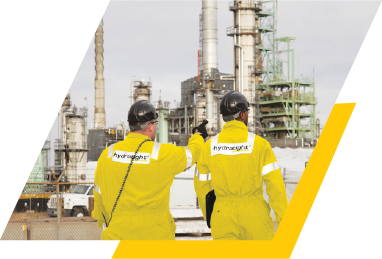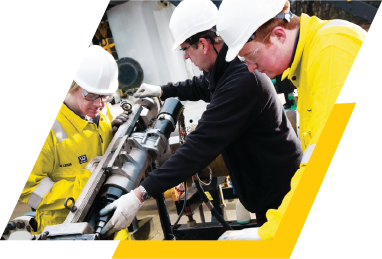
For maintenance, turnaround and asset integrity teams, on-site flange facing provides a way to restore sealing surfaces without removing the flange or transporting large components to a workshop. It can be used across pipework, valves, heat exchangers and other equipment where the condition of the flange face is important to reliable joint assembly.
The flange face provides the sealing surface for the gasket or, in the case of an RTJ flange, the machined groove that accommodates the ring-type joint.
The condition and geometry of this surface therefore form part of the overall bolted-joint integrity. Damage such as corrosion, pitting, scoring or mechanical impact can prevent the gasket from achieving the intended seal. Cross-face damage can be particularly problematic because it can create a leakage path across the sealing surface.
A flange does not necessarily need to be replaced simply because its sealing surface is damaged. Where sufficient material remains and the application permits machining, controlled removal of material can restore the face to the required condition.
This is where flange facing machines provide a practical alternative to component removal or replacement.
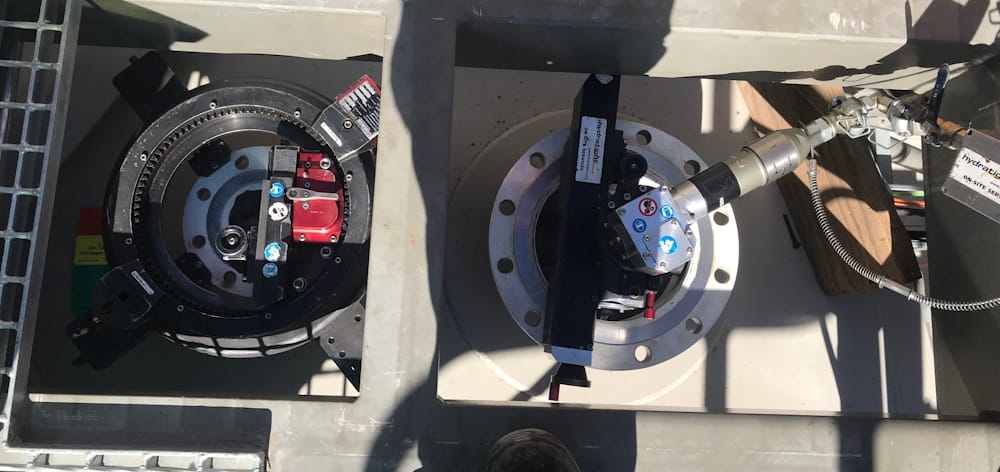
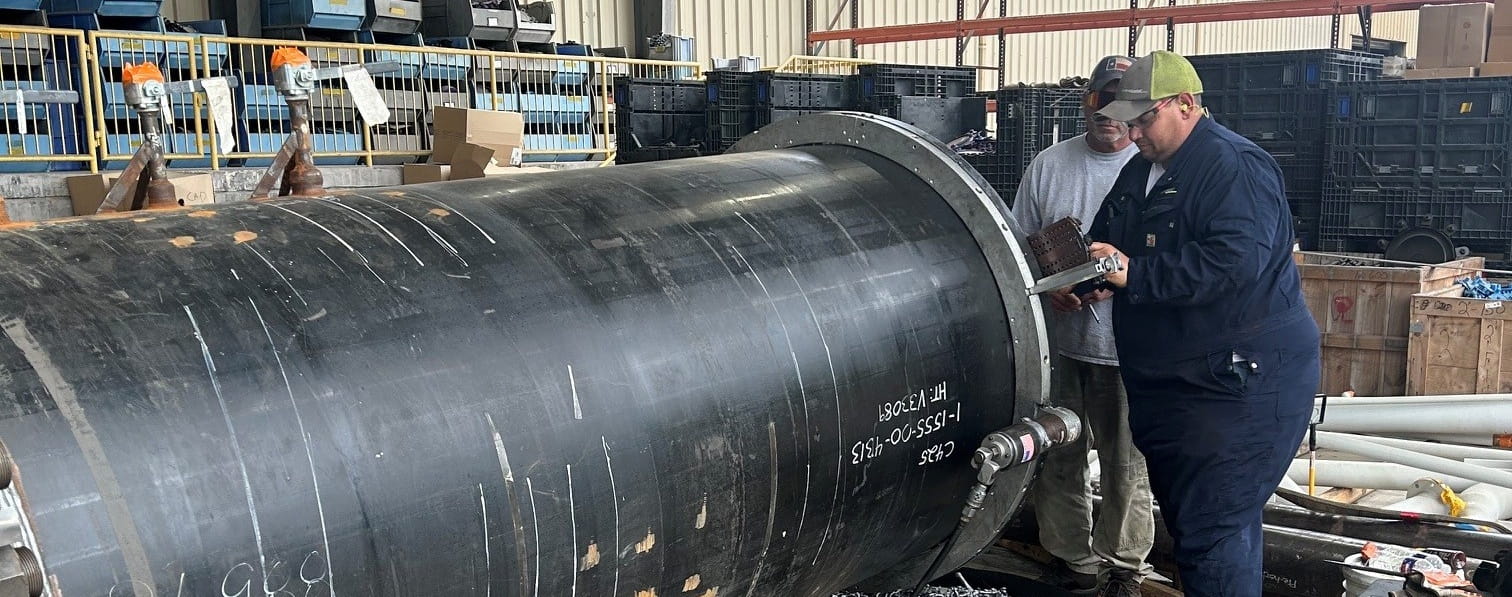
Portable flange facing machines are designed to machine a flange face in situ. The machine is mounted to the flange and a cutting tool travels across the surface in a controlled spiral path.
The objective is not simply to make the flange flat. The machining process needs to produce the appropriate surface geometry and finish for the joint and gasket being used.
For many industrial flange applications, this involves producing a controlled spiral serrated finish. The resulting grooves provide the surface profile required for the specified gasket and joint arrangement.
Hydratight's flange facing service uses portable machining equipment to restore damaged or out-of-tolerance flange surfaces in situ. The service includes assessment of the existing flange condition, machining of the sealing surface and verification against the applicable requirements.
Keeping the machining operation on site can be particularly valuable where the alternative would involve removing a large valve, pipe spool, heat exchanger or other item of plant.
Flange facing is relevant anywhere flange condition can affect the integrity of a pressure-containing joint. Applications are found across oil and gas, petrochemical processing, power generation, nuclear facilities, shipbuilding and other industrial environments.
Flange faces can become damaged during installation, dismantling or maintenance. Corrosion can also develop around flange joints during service.
During a shutdown or turnaround, a flange facing machine can be used to restore the surface before the joint is reassembled. This can avoid replacing an otherwise serviceable flange simply because its sealing face has deteriorated.
Heat exchangers can present a particular challenge because their flange faces can be large and difficult to remove for conventional workshop machining.
Flange facing machines can be configured for different mounting arrangements, including external mounting where access to the flange bore is restricted. Heat exchanger-specific mounting arrangements are also available for appropriate applications.
This makes portable machining relevant to refurbishment work where corrosion, pitting or other damage has affected the sealing surfaces.
Ring Type Joint (RTJ) flanges require a correctly machined groove to accommodate the metal ring gasket. RTJ connections are commonly associated with high-pressure and high-temperature applications, including oilfield equipment, pipework and pressure-containing equipment.
Repairing an RTJ flange is therefore not simply a matter of resurfacing the flat face. The groove geometry and machining requirements need to be considered as part of the repair.
A suitable flange facing machine with the appropriate tooling can be used for RTJ groove machining where the application and remaining flange dimensions permit repair.
One of the practical decisions when selecting a flange facing machine is how it will be mounted. Internally mounted flange facers locate within the flange bore. This configuration is widely used where the bore is accessible and provides a suitable mounting arrangement.
Externally mounted flange facers clamp around the outside of the flange. They can be advantageous where access to the bore is restricted or where the application makes internal mounting undesirable.
The correct configuration depends on the flange dimensions, available access, component geometry and the specific machining requirement. Equipment ranges are available with different mounting arrangements to cover different applications. For large heat exchanger flanges, for example, external mounting can remove the need to use the tube bundle as part of the machine mounting arrangement.
Achieving the correct surface finish is an important part of flange restoration.
The required finish depends on the flange and gasket specification. A flange face that is visibly smooth is not necessarily suitable for the intended gasket or joint.
Flange facing machines use controlled feed mechanisms to generate a consistent machining pattern. For applications requiring a spiral serrated finish, the relationship between rotational speed and tool feed determines the resulting groove pattern.
The applicable flange, gasket and joint specifications should therefore be established before machining begins. The machining process should then be selected and verified against those requirements rather than treating surface finish as a cosmetic consideration.
Flange damage is often discovered when equipment is already open for inspection or maintenance.
That creates a scheduling problem. If the flange cannot be returned to an acceptable condition, the maintenance team may face additional work involving component replacement, workshop machining or extended equipment downtime.
Having access to portable flange facing equipment can provide another option.
The machine can be mobilised to the equipment rather than the equipment being transported to a machine shop. For planned shutdowns, this can allow flange restoration to be incorporated into the work scope. For unplanned maintenance, it can provide a means of addressing flange damage without automatically committing to component replacement.
The actual machining operation can be relatively short; however, machine selection, positioning, alignment, set-up and verification all need to be incorporated into the work plan.
There is no single right way to access a flange facing machine. The appropriate option depends on the frequency and complexity of the work and the capability available within the maintenance organisation.
Using a specialist service provider can be appropriate when the work requires experienced machinists, specialist tooling or a rapid response. The service provider supplies the equipment and personnel and manages the machining operation at the worksite.
This can be particularly useful for complex shutdowns, large-diameter flanges, difficult access conditions or applications where flange restoration is outside the normal capability of the maintenance team.
Flange facing machine rental can be suitable when an organisation has competent personnel and expects to undertake a defined machining project but does not require permanent ownership of the equipment.
Hydratight provides access to specialist industrial tooling through its rental service, including equipment for on-site machining applications.
For organisations with recurring flange machining requirements, purchasing equipment can provide greater availability and reduce dependence on mobilisation for future work. However, the decision should consider more than the initial machine cost. Machine range, tooling, operator competence, maintenance, storage, calibration and the variety of flange sizes likely to be encountered should all be considered when establishing the business case.
The most appropriate flange facing machine depends on the application rather than simply the flange diameter.
Before selecting equipment, the machining scope should establish:
Machine configuration and tooling should then be selected around those requirements.
This is particularly important for non-standard applications, large equipment and work where access is restricted. A technically suitable machine still needs to be capable of being installed, aligned and operated correctly in the available working environment.
Flange facing is ultimately a repair and maintenance option that can extend the useful life of existing equipment or repair damages surfaces during plant construction.
Where a flange sealing surface has deteriorated but the component remains suitable for service, controlled in-situ machining can restore the surface without automatically requiring component replacement. For large or difficult-to-remove equipment, that difference can have a significant effect on the practical scope of the maintenance work.
Hydratight provides flange facing as an on-site machining service, using portable equipment and specialist personnel to assess and restore damaged sealing surfaces. The company can also provide access to equipment through its rental offering, while flange facing machines from the Mirage range are available for organisations looking to establish their own machining capability.
The right solution depends on the flange, the damage, the required finish, access conditions and the resources available for the project. Service, rental and equipment supply therefore provide different routes to the same objective: restoring the flange surface so that the joint can be correctly prepared for reassembly.
For a flange repair or maintenance requirement, the starting point is a clear assessment of the flange dimensions, surface condition, joint specification and site constraints. From there, the appropriate machining method and equipment can be established before work begins.
Clamshell Cutters: Precision Pipe Cutting and Weld Preparation On Site
October 8, 2026
Solving Critical Asset Challenges: Hydratight Services for Industrial Maintenance and Integrity
October 7, 2026
How to Repair Critical Pipeline & Process Equipment Failures Without Shutdown
February 25, 2026
Electrical Discharge Machining (EDM): Precision Material Removal for Critical Components
February 25, 2026
Pipeline & Process System Cleaning: An Overview for Oil, Gas, Petrochemical & Power Industries
February 19, 2026